If your digital twin went quiet a few months after launch, the problem usually isn't capture — it's what happens after. Peer-reviewed research on why adoption stalls, and what actually fixes it.

If you've already rolled out a digital twin, you've probably heard some version of this: everyone was excited at launch, and a few months later, almost no one opens it. A peer-reviewed systematic review published in March 2026, analyzing 160 studies, shows this isn't unique to any one company. This article looks at why an adopted digital twin so often fails to take hold internally, and which kind of tool actually solves that problem.
Table of Contents
- Capture and a Data Layer Are Different Maturity Stages
- Why Adoption Stalls After the Initial Rollout
- Self-Diagnostic Checklist: Where Did Your Rollout Stall?
- Why Beamo Sticks Where Other Tools Don't
Capture and a Data Layer Are Different Maturity Stages
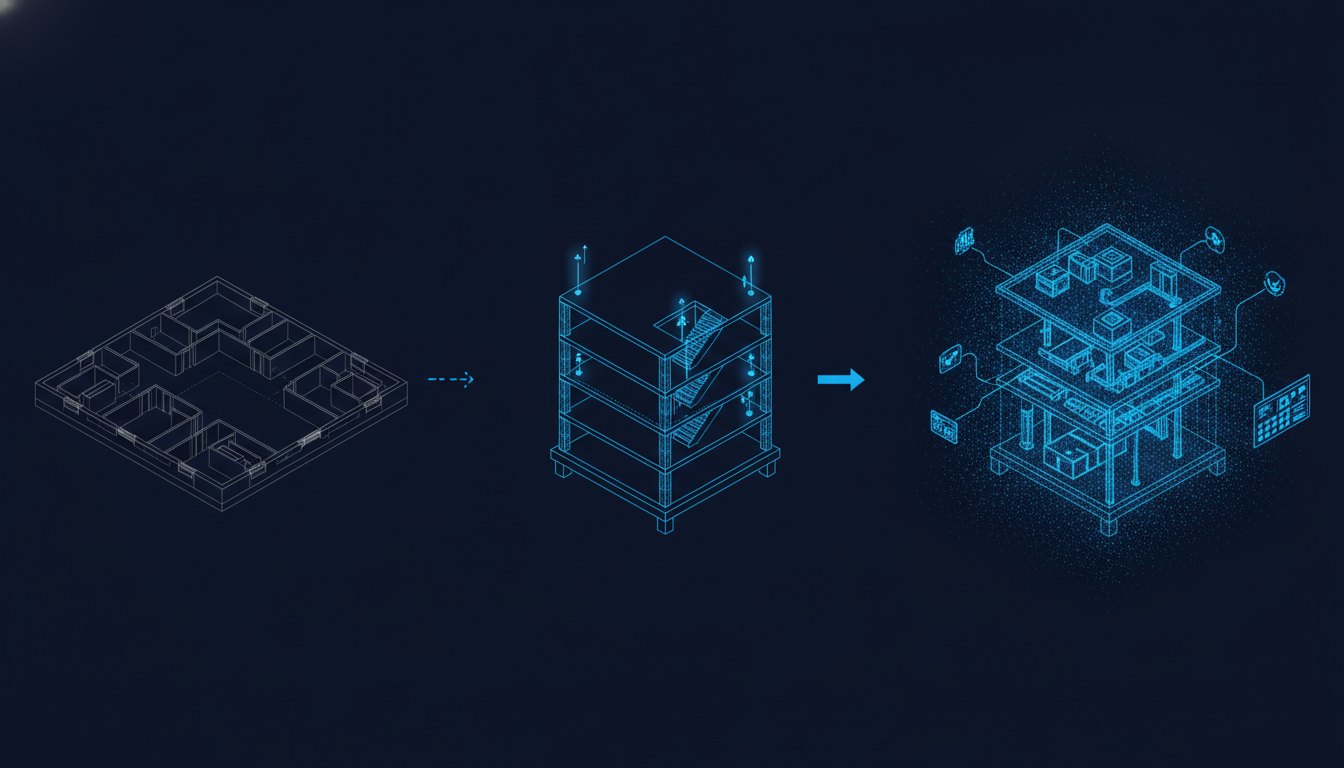
A systematic literature review published in Buildings (MDPI) analyzed 160 peer-reviewed studies selected from 463 records published between 2018 and 2026, using a PRISMA-guided process with inter-rater reliability testing (Cohen's κ = 0.83). The review cites a three-level maturity framework proposed by Kritzinger et al.
- Level 1 — Digital Model: Manual, unidirectional data flow. Changes to either the physical or digital object don't automatically affect the other. Traditional BIM models during design, manually updated by designers, exemplify this level.
- Level 2 — Digital Shadow: Automated, unidirectional data flow. IoT sensors tracking site progress automatically update the digital representation, but changes made in the digital model don't get executed back in the physical site.
- Level 3 — Digital Twin: Automated, bidirectional data flow. Changes to either the physical or digital object automatically update its counterpart, enabling closed-loop control and optimization.
The review states plainly: "Most current construction implementations operate at Level 1 or are transitioning toward Level 2, while actual Level 3 digital twins remain out of reach in most real-world construction contexts."
If you've already adopted a digital twin, this distinction probably sounds familiar. The initial project usually succeeds at scanning the site and building a model (Level 1). The problem shows up afterward — that model rarely becomes a living data layer that gets continuously updated and actually used across teams (Level 3). More often, it becomes a file that one person opens occasionally.
Why Adoption Stalls After the Initial Rollout
The review's most specific analysis centers on the handover stage — the transition from construction to operations. This is usually where the stalling begins.
Several concrete mechanisms show up repeatedly.
- Field changes go undocumented. Under schedule and workload pressure, teams tend to prioritize the task in front of them over digital record-keeping, so the gap between the model and the actual site widens over time.
- System integration itself is a technical and organizational barrier. Connecting the original captured model to facility management systems, building automation platforms, and maintenance databases is difficult. Different structures and terminology mean the systems don't talk to each other, so each team ends up managing data its own way.
- Accountability gets fuzzy over time. As time passes, it becomes unclear who's actually responsible for keeping the digital twin updated, and the model gets neglected exactly when sustained use matters most.
- Organizational discontinuity sets in. The team that championed the initial rollout is often not the team using the data day to day. Priorities differ, and under traditional tooling, the two teams' needs rarely stay aligned.
These four factors compound each other, which is why a project that worked well at launch quietly falls out of use over time. The review also notes that these limits become especially visible when organizations try to scale beyond a single pilot — a tool that worked on one site doesn't necessarily scale into the organization's actual workflow.
Self-Diagnostic Checklist: Where Did Your Rollout Stall?

If you've already adopted a digital twin, check whether three or more of the following apply. If so, you're likely stuck at the capture stage rather than actually adopted.
- Updates slowed down or stopped entirely after the initial scan
- Field teams and operations/facility management teams manage data in separate systems
- There's no clear answer to "who's responsible for keeping this model updated"
- Usage dropped noticeably once the person who championed the rollout moved on
- It worked well on one site or project, but never spread to other sites or the organization as a whole
Why Beamo Sticks Where Other Tools Don't
Each of the four failure patterns above has a specific root cause, and Beamo is built around addressing each one directly.
Updates stop because capture itself is a hassle. Tools that require specialized equipment or a dedicated crew might get budget for an initial pass, but everything after that loses priority. Beamo takes 5 to 10 minutes with just a 360-degree camera, so field staff can recapture regularly without special training. When updating is easy, it actually happens.
Systems don't integrate because each capture ends up as a separate file. Beamo stacks every capture on the same absolute coordinates, so history keeps connecting to the same spatial frame over time. Data created during construction and data created during operations don't scatter into separate systems — they stay in one continuous layer.
Accountability gets fuzzy because there's usually a single "digital twin owner," and when that person leaves, no one picks it up. Beamo is simple enough that it doesn't depend on one specialist. When responsibility changes hands, the next person can pick up capturing and using it immediately.
Organizational discontinuity happens because construction-phase tools and operations-phase tools are usually different products entirely. Beamo runs on the same platform through construction and through post-completion operations and facility management. Teams can change without needing to migrate or convert the data.
If you've already tried capturing with another tool and it didn't stick, the problem was likely never the capture itself — it was what came after: whether the structure supported sustained use.
Conclusion
Companies whose digital twins fail to stick share a clear pattern: they captured the site (Level 1), but that data never became a continuously updated, true data layer (Level 3). As the peer-reviewed literature shows, this isn't primarily an execution failure by individual companies — it's a structural pattern that shows up repeatedly after rollout: undocumented field changes, semantic mismatches between systems, unclear accountability, and organizational discontinuity.
Check how many of the items above apply to what you're using right now. A Beamo demo will show you exactly how your existing data can carry over into a data layer built to keep being used.
References
- Dong, K. & Moshood, T.D. (2026). Digital Twins Across the Asset Lifecycle: Technical, Organisational, Economic, and Regulatory Challenges. Buildings, 16(5), 1084. https://doi.org/10.3390/buildings16051084
- Kritzinger, W. et al. — Digital twin three-level maturity framework (cited within the review above)